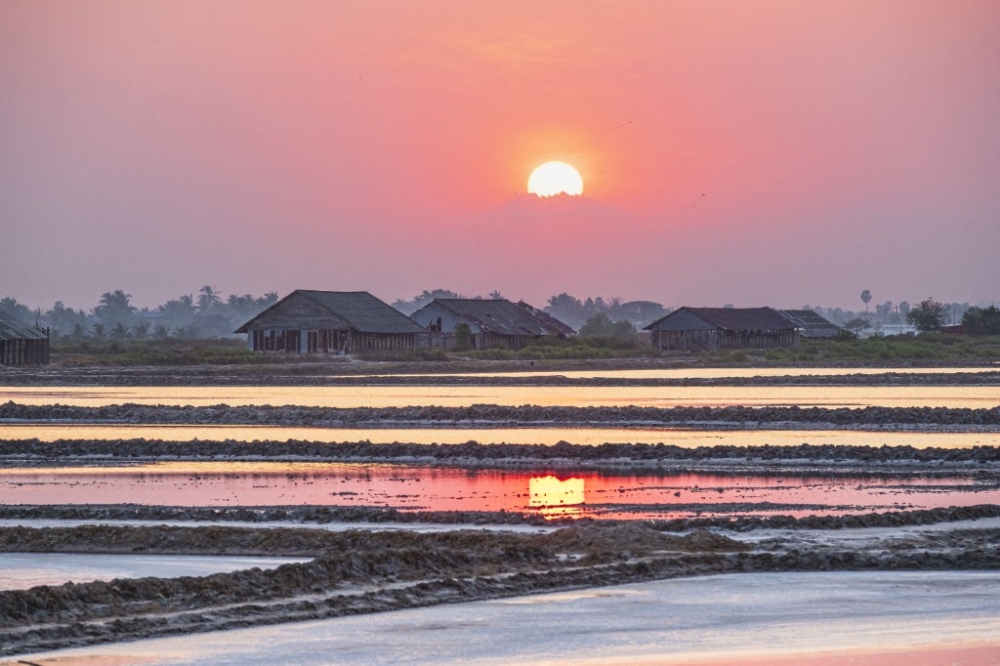
Too much rain, too little sun: Cambodia’s salt farmers face a changing climate
By Vijian Paramasivam PHNOM PENH, Aug 10 -- Changing monsoon patterns linked to climate change are putting pressure on Cambodia’s sea salt industry, which…
- Center1
- Public / State1
no rewrites detected — all voices distinct

Summary
By Vijian Paramasivam PHNOM PENH, Aug 10 (Bernama) -- Changing monsoon patterns linked to climate change are putting pressure on Cambodia’s sea salt industry, which relies on prolonged dry and sunny conditions for production. According to Cambodia’s National Council for Sustainable Development, the country is highly vulnerable to climate change, ranking 12th globally in the Global Climate Risk Index. A total of 141 producers harvest sea salt using traditional, labour-intensive solar evaporation techniques across the coastal areas of the two provinces.
Furthermore, Kampot and neighbouring Kep province, located about 150 kilometres southwest of Phnom Penh, form the heart of Cambodia’s traditional salt industry, where salt production has been practised for decades. Kampot-Kep salt received Geographical Indication (GI) certification in April 2023, giving the region’s distinctive sea salt greater recognition for its quality and origin. Narin said producers expect to harvest about 75,000 metric tonnes of salt this year, compared with only around 30,000 tonnes in 2025, when persistent rainfall disrupted production.
In addition, The influx of cheaper imported salt, particularly from neighbouring countries, is another concern for local producers, adding further pressure on demand for domestically produced salt. In recent years, unusually heavy rainfall during the dry season has disrupted production in Kampot and Kep provinces, Cambodia’s main salt-producing region. “Over the last five years, production patterns have changed due to heavy rain and high tides (that flood salt ponds). “Climate change is a big challenge for salt production because our production depends entirely on weather conditions,” Association of Geographical Indication Kampot-Kep Salt Producers’ President Bun Narin told Bernama.
Cross-referenced from 2 sources.
Factual coreconfirmed by several independent voices
By Vijian Paramasivam PHNOM PENH, Aug 10 (Bernama) -- Changing monsoon patterns linked to climate change are putting pressure on Cambodia’s sea salt industry, which relies on prolonged dry and sunny conditions for production.
reliability moderate2/2 sourcesAccording to Cambodia’s National Council for Sustainable Development, the country is highly vulnerable to climate change, ranking 12th globally in the Global Climate Risk Index.
reliability moderate2/2 sourcesA total of 141 producers harvest sea salt using traditional, labour-intensive solar evaporation techniques across the coastal areas of the two provinces.
reliability moderate2/2 sourcesKampot and neighbouring Kep province, located about 150 kilometres southwest of Phnom Penh, form the heart of Cambodia’s traditional salt industry, where salt production has been practised for decades.
reliability moderate2/2 sourcesKampot-Kep salt received Geographical Indication (GI) certification in April 2023, giving the region’s distinctive sea salt greater recognition for its quality and origin.
reliability moderate2/2 sourcesNarin said producers expect to harvest about 75,000 metric tonnes of salt this year, compared with only around 30,000 tonnes in 2025, when persistent rainfall disrupted production.
reliability moderate2/2 sourcesThe influx of cheaper imported salt, particularly from neighbouring countries, is another concern for local producers, adding further pressure on demand for domestically produced salt.
reliability moderate2/2 sourcesIn recent years, unusually heavy rainfall during the dry season has disrupted production in Kampot and Kep provinces, Cambodia’s main salt-producing region. “Over the last five years, production patterns have changed due to heavy rain and high tides (that flood salt ponds). “Climate change is a big challenge for salt production because our production depends entirely on weather conditions,” Association of Geographical Indication Kampot-Kep Salt Producers’ President Bun Narin told Bernama.
reliability moderate2/2 sources
Disputedincompatible versions — to verify
No factual contradiction detected between sources.
Framing by sidesame fact, different words — loaded terms highlighted
No notable framing divergence.
Blind spotwhat one side keeps silent
No blind spot detected: every side covers the same facts.
Sources2 sources cross-checked
Center1
Public / State1