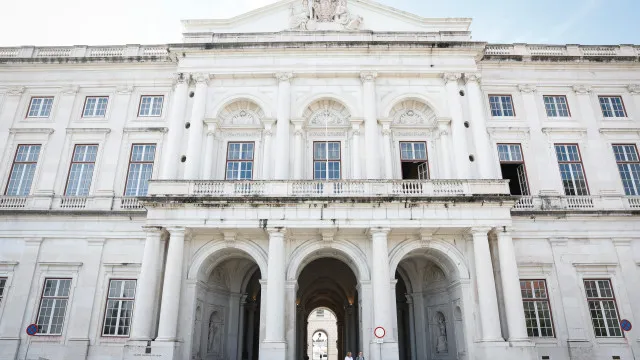
Help Palace receives portrait of King Louis I for permanent exhibition
King Louis I would die on October 9, 1889, in the Palace of the Citadel of Cascais, where he wanted to finish his days
- Center1
- Center-right1
1 agency rewrite / co-publication detected
Summary
King Louis I would die on October 9, 1889, in the Palace of the Citadel of Cascais, where he wanted to finish his days. There he received the invitation to perform the official portrait of Peter V, a work completed in 1860 and whose success earned him a scholarship from the State to pursue studies at the Academy of St. Luca in Rome. The portrait of Louis I now deposited in Help was executed in 1868, at a stage of full artistic maturity.
Furthermore, Born in Lisbon to an Italian family, Miguel Ângelo Lupi began training at the Academy of Fine Arts, but interrupted his studies due to economic difficulties, working at the National Press in Angola, and later at the Court of Auditors in Lisbon. On his return to Portugal, he became a professor of Historical Painting at the Lisbon Academy of Fine Arts and claimed to be one of the favourite portraitists of the bourgeoisie and the Portuguese royal family. The National Ajuda Palace began to exhibit a portrait of King Louis I (1838-1889), painted by Michelangelo Lupi (1826-1883), following a deposit from the collection of the General Deposit Box (CGD).
Cross-referenced from 2 sources.
Factual coreconfirmed by several independent voices
King Louis I would die on October 9, 1889, in the Palace of the Citadel of Cascais, where he wanted to finish his days.
reliability low1/2 sourcesThere he received the invitation to perform the official portrait of Peter V, a work completed in 1860 and whose success earned him a scholarship from the State to pursue studies at the Academy of St. Luca in Rome.
reliability low1/2 sourcesThe portrait of Louis I now deposited in Help was executed in 1868, at a stage of full artistic maturity.
reliability low1/2 sourcesBorn in Lisbon to an Italian family, Miguel Ângelo Lupi began training at the Academy of Fine Arts, but interrupted his studies due to economic difficulties, working at the National Press in Angola, and later at the Court of Auditors in Lisbon.
reliability low1/2 sourcesOn his return to Portugal, he became a professor of Historical Painting at the Lisbon Academy of Fine Arts and claimed to be one of the favourite portraitists of the bourgeoisie and the Portuguese royal family.
reliability low1/2 sources
Reported detailssecondary facts, each attributed to its source
The National Ajuda Palace began to exhibit a portrait of King Louis I (1838-1889), painted by Michelangelo Lupi (1826-1883), following a deposit from the collection of the General Deposit Box (CGD).
according to Jornal Económico
Disputedincompatible versions — to verify
No factual contradiction detected between sources.
Framing by sidesame fact, different words — loaded terms highlighted
No notable framing divergence.
Blind spotwhat one side keeps silent
No blind spot detected: every side covers the same facts.
Sources2 sources cross-checked
Center-right1